
Have you ever been through this — switching shampoos three or four times, moving from drugstore conditioner up to salon lines, and your hair still comes out frizzy, dry, and dull once it's dried? You stare at the ingredient list trying to figure out if it's the silicones, the sulfates, or whether your hair is just a lost cause.
As a former formulation chemist, I can tell you the answer that usually gets overlooked: the towel you dry your hair with might matter more than which product you buy.
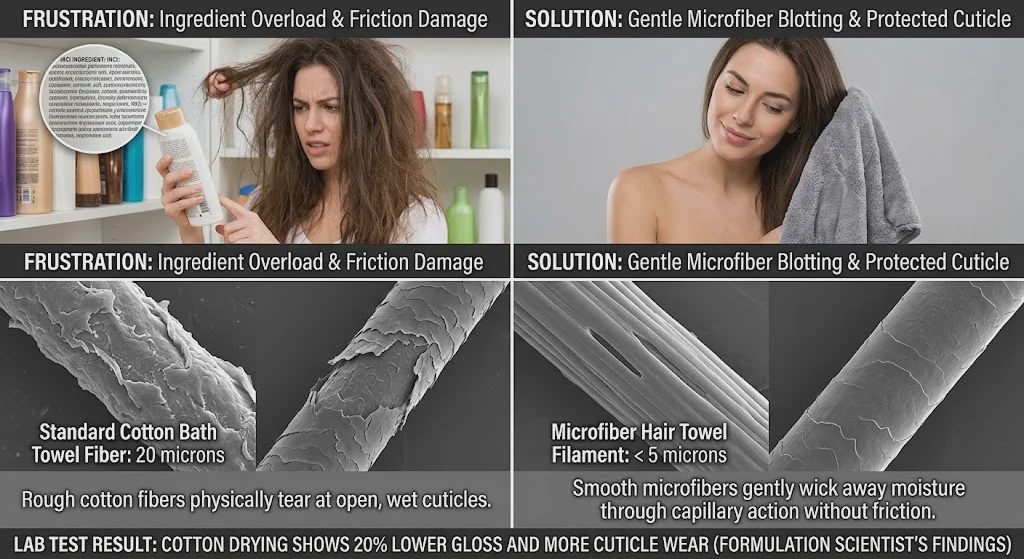
During my eight years in the lab, I ran hundreds of hair-strand tests. Same shampoo, same strand, only one variable changed — how the hair was dried. One group got rubbed with a cotton bath towel, the other was blotted and wrapped in microfiber. The result: the cotton-dried strands showed visibly more cuticle wear, and gloss-meter readings came in nearly 20% lower.
Physical Damage Isn't Something Ingredients Can Fix
The gap isn't just because cotton is rougher — although it is. It comes down to what's happening to wet hair at the cuticle level: when hair is wet, the cuticle layer is lifted open, its elasticity drops, and its tensile strength is less than half of what it is when dry. Every pass of a rough towel is, mechanically speaking, tearing at that protective layer while it's at its weakest. Once the cuticle is worn away, the cortex underneath is exposed — and no amount of keratin treatment or high-end hair mask puts that back. That's not a formula problem. It's physical damage.
Which is also why the order of your post-wash routine matters more than which bottle you agonize over on the shelf — a point that tends to get buried under marketing, because "buy the right product" is simply an easier pitch than "do this correctly."

My old towel had stopped absorbing much of anything last month, so I switched to a BEoffer microfiber hair towel — a two-pack, 41 x 24 inches, $9.49. It fastens with a built-in elastic band, so once it's wrapped it stays put without a hand holding it in place. That detail sounds minor, but it solves the exact thing that makes "blot instead of rub" hard to stick with: most people don't abandon the correct technique because they don't understand it, they abandon it because doing it one-handed is genuinely annoying. The time that used to go toward holding a towel up now goes toward the rest of the routine — moisturizer, a neck massage, or just letting your skin sit in the steam a little longer. Post-wash care is supposed to be unhurried. It shouldn't be a race against a towel slipping off your head.
So Why Is Microfiber Different?
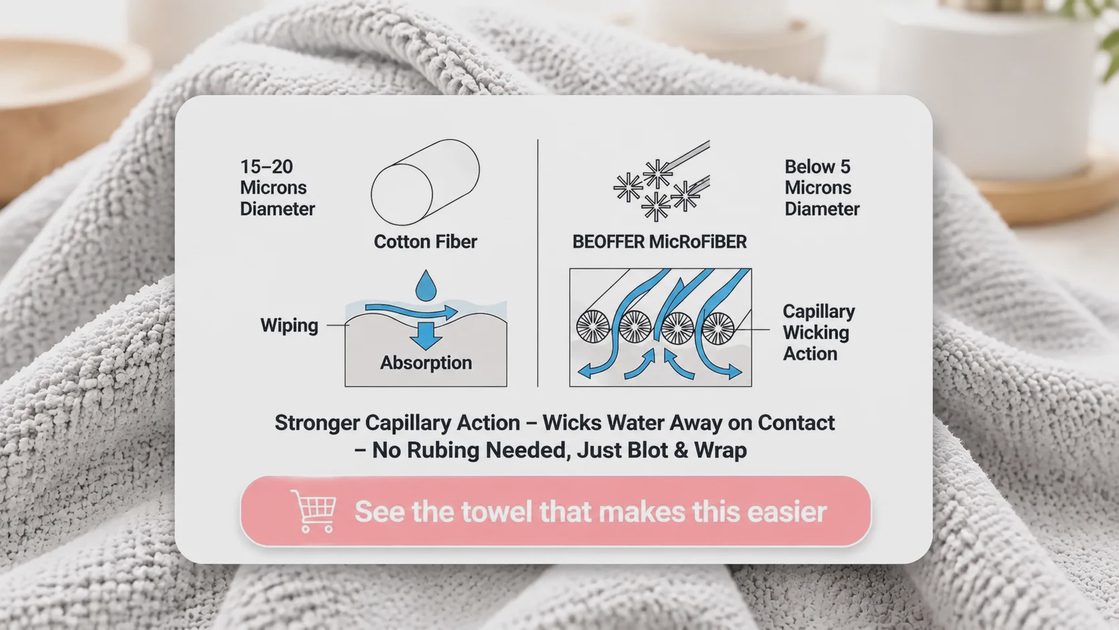
Most people assume the appeal of microfiber is that it's soft — that's a misunderstanding. What actually sets it apart is fiber diameter and surface area. A standard cotton fiber runs 15–20 microns across; microfiber can get down below 5 microns. For the same surface area, microfiber's capillary action is several times stronger than cotton's — the mechanism isn't "wiping," it's "wicking." You don't need to rub back and forth. Blot and wrap, and the water is pulled away on its own.
The Four-Step Wash-Day Routine Most People Get Backwards
Step one: blot, don't rub. Wrap sections of hair and press gently. That's enough to remove most of the excess water — rubbing does nothing extra with microfiber and just adds unnecessary damage.
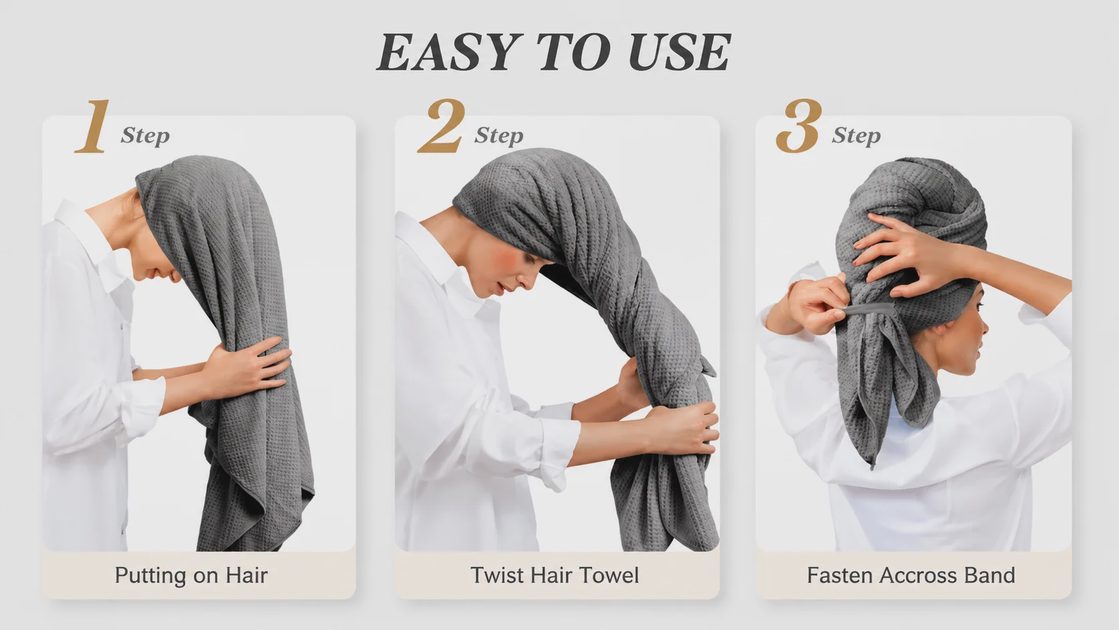
Step two: apply leave-in treatment or serum while hair is still 80–90% wet. The cuticle hasn't fully closed yet, so absorption is at its best. Wait until hair is fully dry and most products just sit on the surface.
Step three: detangle from the ends up, using a wide-tooth comb. Working top-down from the root drags every knot tighter. Starting at the ends and working upward meets far less resistance.
Step four: air-dry or use a low heat setting, and don't leave a towel wrapped on your head for long stretches. The wrap itself isn't the problem — leaving it on too long, or too tight, is. Sustained tension at the root causes breakage, and that has nothing to do with whether your shampoo is labeled "repair."
What This Looks Like in Practice
I've timed this BEoffer towel a few times: wrapped for three to five minutes, most of the water is gone, and hair goes from "dripping" to "damp" — not fully dry, just no longer dripping. Blow-dry time drops by close to half after that. That's not because the towel is doing anything exotic. It's a fiber diameter an order of magnitude smaller, and the physics plays out accordingly.

If you're considering trying one, three practical notes: look for a snap or elastic-band closure so it stays wrapped without a hand holding it. Skip fabric softener when washing it — softener coats the fibers and blocks the capillary action, which noticeably tanks the absorbency. And check the size: 41 x 24 inches is the standard, which covers shoulder- to waist-length hair comfortably, but if your hair is unusually thick or very long, you may find the coverage a bit short. I went with the gray-and-blush two-pack; it also comes in solid gray, camel, and a few other colors — that part's just aesthetic and doesn't affect performance.
A towel Set under $9.49can make a bigger difference than swapping in a $50 shampoo. Not because there's anything special about the towel itself, but because the way most of us dry our hair is quietly working against us — and nobody ever mentions it.
Read the label before you buy the bottle. And maybe check what you're drying it with, too.


No notes yet — write the first one.