
Most people treat their wash routine like a checklist: shampoo, conditioner, maybe a mask, done. The order feels obvious, so they stop thinking about it.
In the lab, order is never treated as obvious. The sequence in which products hit the hair changes what actually stays on the hair, how evenly it distributes, and whether the next product can do its job. A perfectly good conditioner can underperform simply because it was applied on top of residue the shampoo didn’t fully clear. A leave-in can pill or sit on the surface if the hair wasn’t properly prepared.
This is not about adding more steps. It is about making the steps you already take work better.
Why sequence changes the result

Hair is not a static surface. After shampooing, the cuticle is slightly lifted and the hair is more receptive to conditioning agents. If you apply a heavy mask before the hair is fully cleansed, some of that mask material binds to leftover oils and product instead of to the hair itself. If you layer a leave-in over a rinse-out conditioner that hasn’t been properly emulsified and rinsed, you can end up with uneven deposits and a coated feel.
Formulators design products with the expectation that they will be used in a logical order. When that order is ignored, the performance drops even if every individual product is well-made.
A clear, functional order
Here is the sequence I recommend for most people, with the reasoning behind each step.
Clarify or regular shampoo (as needed) Start with a clean surface. If you are using a clarifying shampoo that day, this is the time. Otherwise use your regular shampoo. Focus on the scalp; let the lather run through the lengths. The goal is to remove sebum, sweat, and product residue so the next products have something to attach to.
Rinse thoroughly This step is underrated. Leftover surfactant can interfere with conditioning. Take the extra twenty seconds.
Conditioner or mask Apply from mid-lengths to ends (or roots to ends if your hair is very dry or damaged). This is the moment the hair is most ready to accept positively charged conditioning agents. If you are using a mask, this is its place — not before shampoo, and not after a leave-in.
Rinse (with intention) How completely you rinse depends on what you want left behind. A light rinse leaves more conditioning material on the hair; a thorough rinse leaves less. There is no universal “correct” amount — it depends on your hair’s needs that day.
Leave-in conditioner or treatment (optional but useful) Apply to damp, not dripping, hair. At this stage the rinse-out product has already done its main work. The leave-in is there for ongoing detangling, light moisture, and protection while the hair dries.
Styling products Gels, creams, oils, and serums go on last. They are designed to sit on or near the surface and control frizz, define shape, or add shine. Putting them on earlier usually means you rinse a good portion of them away or create uneven layers.
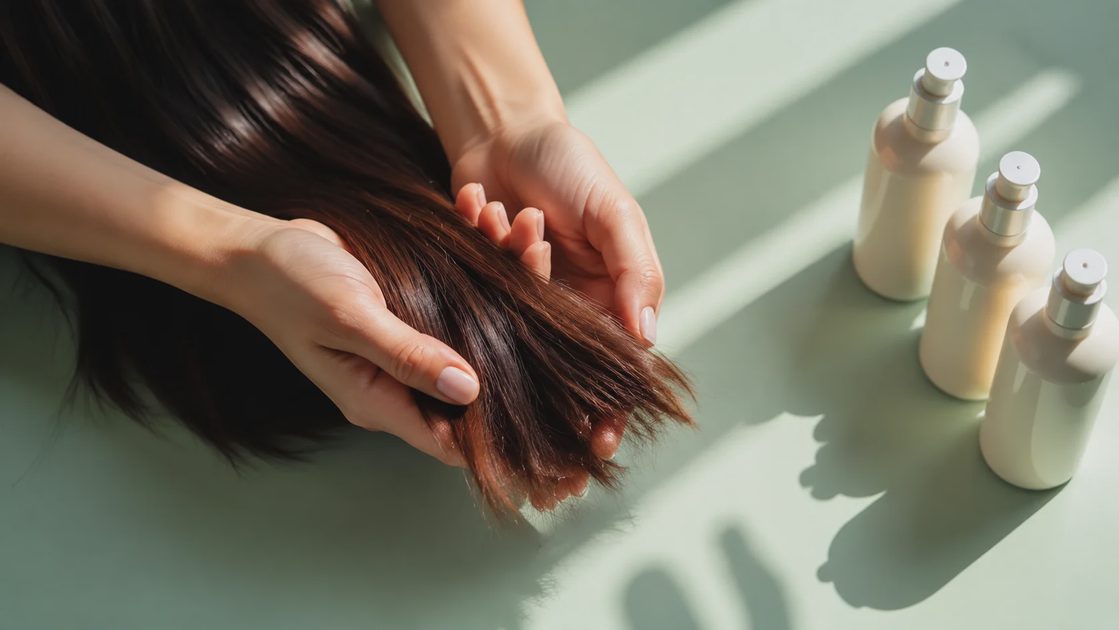
Common order mistakes I see
Applying oil or a heavy cream before shampoo “to protect the hair.” Most of it gets washed off, and what remains can make cleansing less effective.
Using a mask every wash and then layering a rich leave-in on top without adjusting amounts. This is how hair starts to feel coated and limp.
Putting leave-in on soaking-wet hair and then adding more product as it dries without redistributing. You end up with concentrated clumps in some areas and nothing in others.
Skipping conditioner entirely because “shampoo is enough,” then wondering why the hair feels rough and tangles easily.
Adjusting for different needs
Fine or easily weighed-down hair: Keep the rinse-out conditioner light and focused on the ends. Use a lighter leave-in or skip it on some wash days.
Thick, dry, or high-porosity hair: You can be more generous with the mask and leave-in. The order stays the same; the quantities change.
Curly or coily hair: Many people benefit from applying conditioner or leave-in with a bit more water still in the hair (the “praying hands” or scrunching methods). The sequence of product types remains the same.
Color-treated or chemically processed hair: Avoid clarifying too often, but when you do clarify, follow immediately with a good conditioning step. The hair is more porous and will grab what you give it.
A note on “reverse washing” and other variations
Some people shampoo only the scalp and apply conditioner first to the lengths (sometimes called pre-poo or reverse washing). These methods can work well for dry or textured hair. They are not wrong — they are simply different strategies for managing how much cleansing reaches the ends. The underlying principle remains: clean where you need cleansing, condition where you need conditioning, and don’t make the products fight each other.
The practical takeaway
You do not need a ten-step routine. You need the steps you already use to arrive in an order that lets each product do what it was formulated to do.
Clean first.
Condition while the hair is receptive.
Seal and style last.
Watch how your hair feels over the next two or three wash cycles when you keep this sequence consistent. Most people notice better detangling, more even moisture, and less need to layer extra products on top.
The label tells you what is in the bottle. The order you use those bottles determines how much of that formula actually ends up working for your hair.



No notes yet — write the first one.