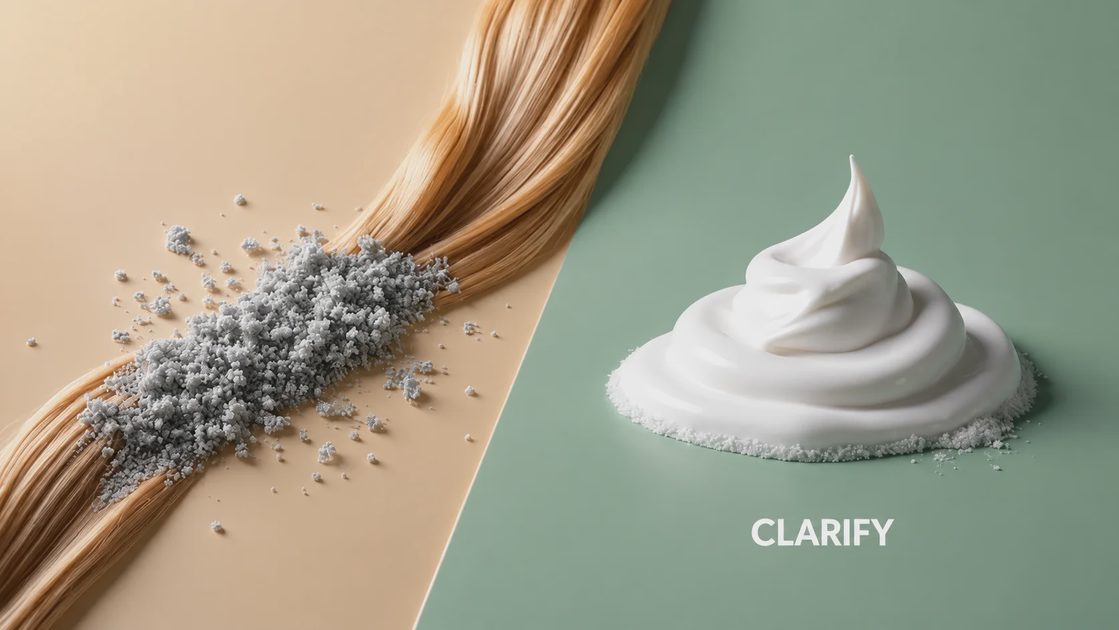
Most people treat clarifying shampoo like a nuclear option.
They either never use it, or they reach for it the moment their hair feels slightly off and then wonder why everything feels dry and squeaky for the next week. Both approaches miss the point.
Clarifying shampoo is a tool. Like any tool, it works best when you understand what it is designed to remove — and what it is not designed to do every time you wash.
What clarifying shampoo actually does

Regular shampoo is formulated to clean sebum, light product residue, and everyday dirt while leaving enough conditioning agents behind so hair doesn’t feel stripped.
Clarifying shampoo is different. It is built with stronger (or higher levels of) surfactants and fewer, or lighter, conditioning ingredients. Its job is to remove the buildup that regular shampoo leaves behind over time:
Silicones that have accumulated
Heavy conditioning agents and oils
Styling product residue (gels, mousses, dry shampoo, texturizing sprays)
Mineral deposits from hard water
The invisible film that can make hair look dull or feel coated
It is not “deeper cleaning” in a magical sense. It is more thorough cleaning of specific residues. That thoroughness is useful — until it isn’t.
When you actually need it
You probably need a clarifying shampoo if several of these are true:
Your hair feels coated or heavy even right after washing and conditioning.
Products that used to work suddenly seem to sit on top of the hair instead of absorbing.
Your hair looks dull or flat no matter what you apply.
You live in a hard-water area and notice mineral buildup (hair can feel stiff or look slightly chalky).
You use a lot of leave-in products, oils, or silicone-heavy stylers.
You’re preparing for a chemical service (color, keratin, permanent wave) and want a cleaner starting point.
You’ve been swimming in chlorinated or salt water frequently.
A good rule of thumb I used in the lab: if hair is rejecting moisture or product the way a waterproof jacket rejects water, something is sitting on the surface that needs to be cleared.
When you’re overdoing it
Clarifying too often is one of the fastest ways to create the exact problems people then try to solve with more products.
Signs you may be over-clarifying:
Hair feels squeaky, straw-like, or overly porous after washing.
You need significantly more conditioner or mask than usual just to feel normal.
Frizz increases and the hair cuticle feels rough.
Color fades faster than expected.
Your scalp feels tight or dry.
Most people with normal to dry hair only need clarifying every 3–6 weeks, sometimes less. Oily scalps or heavy product users might go every 2–3 weeks. Daily or twice-weekly clarifying is almost never necessary unless you are dealing with extreme buildup or specific professional situations.
I made this mistake early in my career. I clarified too aggressively on my own hair because I thought “clean” meant “stripped.” It took months of repairing the damage before I understood that removing everything is not the same as cleaning well.
How to use it without creating new problems
Wet hair thoroughly. Clarifying shampoos work better on fully saturated hair.
Focus on the scalp and lengths separately. Emulsify the product in your hands first, then apply. Spend most of the time on the scalp if buildup is heavier there; gently work through the lengths.
One good lather is usually enough. Two if the buildup is significant. More than that is rarely productive.
Follow with a conditioner or mask that actually deposits. Because you have removed more residue, the hair is more receptive — this is the moment a decent conditioner can do its best work.
Consider a chelating shampoo if hard water is your main issue. These are formulated specifically to bind and remove mineral deposits and are often gentler than a full clarifying formula.
You do not need the most expensive clarifying shampoo on the shelf. Look at the ingredient list. Effective clarifying formulas often feature stronger anionic surfactants (such as sodium lauryl sulfate, sodium laureth sulfate, or similar) higher up, with minimal heavy conditioning agents. That is the functional signal, not the price or the “detox” language on the front.

A practical cadence
Light product user, soft water: every 4–6 weeks or as needed.
Regular styler / dry shampoo user: every 3–4 weeks.
Hard water + heavy products: every 2–3 weeks, or alternate with a chelating wash.
After swimming or before a chemical service: as a targeted reset.
Pay attention to how your hair feels and behaves over the following days, not just immediately after the wash. That feedback is more useful than any rigid schedule.
Clarifying shampoo is not a personality trait or a moral stance about “clean” versus “natural.” It is simply a more thorough surfactant system for specific situations. Used with intention, it keeps the rest of your routine working. Used by habit or fear, it creates the dryness and frizz that then send people hunting for the next repair product.
Read the label. Notice where the stronger cleansers sit and how little conditioning material follows them. That tells you what the bottle is actually designed to do.
Then decide whether today is a day you need it.





No notes yet — write the first one.