
You've probably heard this advice: "Train your scalp to produce less oil by washing less frequently."
The theory is that if you stop washing so often, your scalp will "realize" it doesn't need to produce as much oil and will gradually calm down.
I need to tell you: there is no scientific evidence that this works.
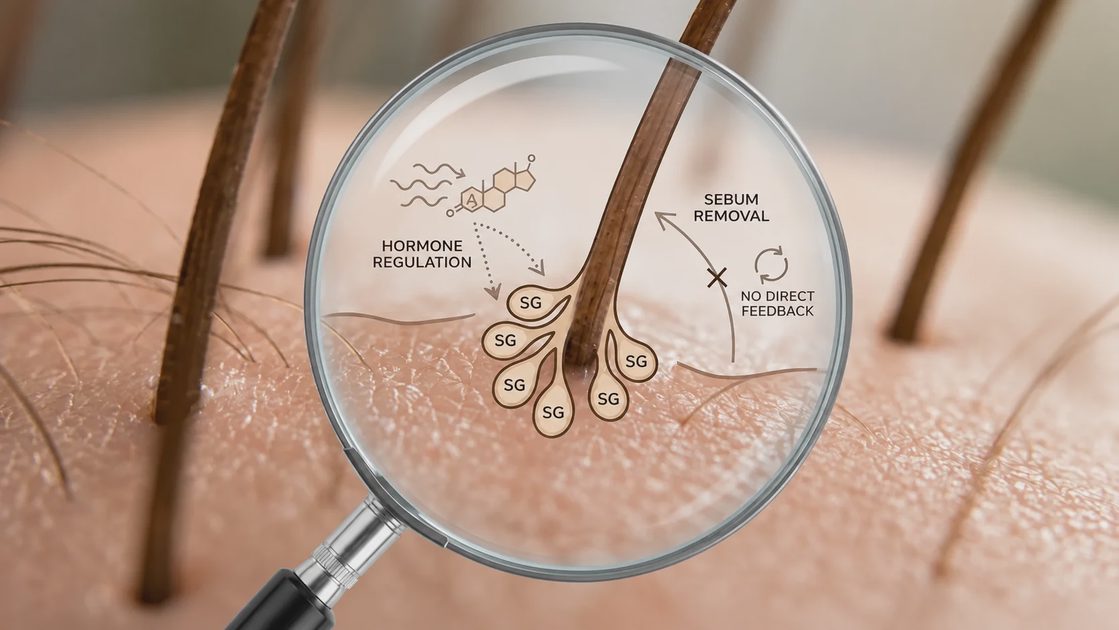
Your sebaceous glands don't have a feedback loop that monitors how often you wash. Sebum production is regulated by hormones – primarily androgens – not by how frequently you remove the oil from your scalp's surface.
If you go from washing every day to washing once a week, your scalp isn't "learning" to produce less oil. It's just accumulating more oil between washes. Eventually, the oil sits on your scalp for so long that it oxidizes, mixes with dead skin cells, and can actually contribute to irritation or buildup.
Can some people extend the time between washes? Yes. But that's usually because their hair texture or density allows them to hide the oil, not because their scalp has actually changed its oil production.
The "training" advice also completely ignores the psychological reality: walking around with greasy hair for weeks to "train" your scalp is unpleasant, especially when it doesn't actually work.
A Framework, Not a Number
I'm not going to tell you to wash your hair every other day or twice a week. That would be irresponsible because I don't know your scalp, your hair, or your lifestyle.
Instead, here's a framework.
Start with your scalp.
This is the most important factor. Your scalp's oil production largely determines how often you need to wash.
Your Scalp Type | What It Looks Like | Suggested Wash Frequency Range |
|---|---|---|
Oily scalp | Feels greasy by the end of the day; hair looks flat at the roots after 24 hours; you can feel oil on your fingertips when you touch your scalp. | Every 1–2 days |
Normal scalp | Feels clean for 2–3 days; oil is noticeable but not heavy by day 3; no irritation or flaking. | Every 2–3 days |
Dry scalp | Doesn't feel oily even after 4–5 days; may experience flaking or tightness; hair feels dry at the ends. | Every 4–7 days |
Sensitive scalp | Reacts to frequent washing (itchiness, redness, tightness); prone to irritation from certain cleansers. | Every 3–5 days, with gentle cleansers |
Then consider your hair.
Your hair type and texture can tell you a lot about how much washing it can tolerate.
Your Hair Type | What It Tells You | Effect on Frequency |
|---|---|---|
Fine and straight | Oil travels down the hair shaft quickly. Roots look flat soon after washing. | May need to wash more often (closer to the scalp's maximum). |
Thick and wavy | Oil travels more slowly but is still noticeable. Hair can go a bit longer. | Can stretch a day or two beyond scalp frequency. |
Curly or coily | Oil has a hard time travelling down the hair shaft. The ends stay dry even when the scalp is oily. | Wash for the scalp, not the ends. Ends need conditioners and leave-ins, not frequent washing. |
Damaged or chemically treated | Hair is porous and fragile. Frequent washing can cause more damage. | Consider less frequent washing (closer to the scalp's minimum). |
Factor in your lifestyle.
Do you exercise heavily? Sweat can cause build-up on the scalp, and if you leave it, it can dry and cause irritation. You might need to rinse more often.
Do you work in a dusty environment or use a lot of styling products? You might need to wash more frequently than your scalp type alone would indicate.
Do you live in a humid climate? Humectants in the air can make your hair feel less dry, but sweat and humidity can also make your scalp feel greasier.
This framework helps you find your starting point. Then you adjust from there.
When You Should Wash: Three Decision Points
Instead of a rigid schedule, I'd rather give you three decision points. These are questions to ask yourself before you step into the shower:
1. Does my scalp feel uncomfortable?
This is my number one test. If my scalp feels itchy, tight, flaky, or just generally uncomfortable, it's time to wash. An uncomfortable scalp is a sign that something is off. Leaving it that way won't help.
2. Does my hair look like I want it to look?
Hair has a mind of its own. Some days it looks great—bouncy, shiny, full of life. Other days it's flat, limp, or just lacks volume. If your hair looks flat at the roots and lifeless at the ends, washing might give it a fresh start.
3. Is there product buildup that's interfering with my hair's appearance or performance?
If your hair feels coated, weighed down, or isn't responding to your usual products, a wash (and possibly a clarifying one) is the answer.
If you answer "yes" to any of these questions, it's time to wash. If you answer "no" to all three, you can wait another day.
What About In-Between Days?
If you're stretching time between washes, here's how to manage the in-between days:
Use dry shampoo strategically. Dry shampoo absorbs oil at the roots. It won't clean your scalp, but it will help your hair look fresher. Apply it at night before bed rather than in the morning. It absorbs oil overnight and leaves your hair looking fresher in the morning.
Rinse with water only. If you've exercised heavily or just need a refresh, rinsing with water can help remove some surface sweat and oil without stripping your hair.
Switch to a co-wash. A co-wash (conditioner-only cleanser) cleanses more gently than shampoo. It's not strong enough for everyone, but it's great for curly or damaged hair that needs gentle cleansing.
Use a scalp scrub or leave-on treatment. An exfoliating scalp product can help maintain the health of your scalp without removing all the oils from your strands.
Let's Talk About Dry Shampoo Myths

I get asked about dry shampoo constantly. Specifically, "Is it bad for your scalp?"
Here's the honest answer: used correctly, no. Overused, yes.
Dry shampoo absorbs oil. That's its job. It doesn't clean your scalp – it just temporarily reduces the visibility of oil. If you use it repeatedly without washing in between, you're building up a mixture of oil, dry shampoo, and dead skin cells on your scalp. Over time, that can lead to clogged follicles, irritation, and even hair thinning.
So dry shampoo is a useful tool – for one or two days. It's not a substitute for washing.
My Personal Reality
After all this, I should tell you what I do.
I have a normal-to-oily scalp and fine hair. I wash every 2–3 days. On day two, I might use a little dry shampoo at the roots if I have an evening event. By day three, my hair definitely looks flat, and my scalp feels ready for a wash.
In the summer, when I'm sweating from tennis, I wash more often – maybe every other day. In the winter, when my scalp is drier, I might stretch to three days.
I also use a clarifying shampoo once every 2–3 weeks to reset any buildup that regular washing might not remove.
That's what works for me. It won't be what works for you. And that's exactly my point.
When to Adjust Your Frequency
Most people find a natural rhythm and stick with it. But here are some signs that your frequency might be off:
Signs you're washing too often:
Your hair feels dry and brittle.
Your ends are splitting.
Your scalp feels tight or flaky.
Your hair is losing its natural shine.
Signs you're not washing often enough:
Your scalp feels itchy, irritated, or flaky.
Your hair looks limp at the roots.
You have a noticeable odour from your scalp.
Your hair feels heavy or coated.
If you notice any of these, adjust accordingly.
Read the label before you buy the bottle.





No notes yet — write the first one.