If you've spent any time in hair care spaces online, you've seen the warning:
"Avoid silicones at all costs. They coat your hair, block out moisture, and suffocate your strands."
And just like that, Dimethicone – the most common silicone in shampoos, conditioners, and serums – became public enemy number two, right behind sulfates.
But here's what I rarely see mentioned in those viral posts: I've written dozens of formulas that contained dimethicone. And I'd do it again.
Not because I'm lazy. Not because I'm "owned by Big Beauty." But because when you understand what dimethicone actually does – at a molecular level – you realise that avoiding it completely is like throwing out every frying pan in your kitchen because one of them once burned your eggs.
Let's walk through the science. Slowly. Without the fear-mongering.
First: What Is Dimethicone, Exactly?
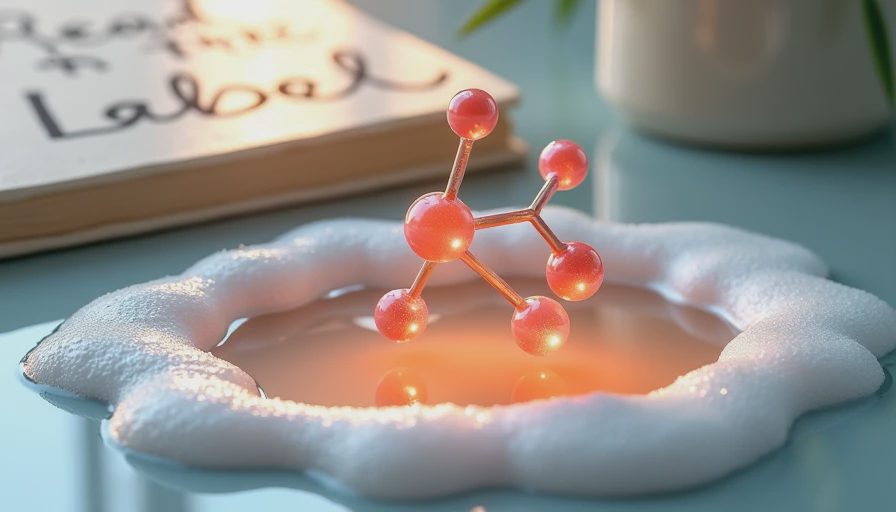
Dimethicone (INCI name: Polydimethylsiloxane, or PDMS) is a silicone‑based polymer. In plain English, it's a clear, odourless, slippery liquid that's incredibly stable and resistant to heat, water, and oxygen.
Chemically, it's built on a backbone of silicon‑oxygen bonds, with methyl groups attached to the sides. That structure gives it two superpowers in hair care:
It forms a thin, breathable film on the surface of each hair strand.
It reduces friction between strands, which translates to instant slip, shine, and detangling.
Think of it like Teflon for your hair – but softer, lighter, and rinseable.
When you apply a conditioner or serum with dimethicone, you're not "clogging" your hair. You're smoothing down the cuticle (the outermost protective layer of scales). When the cuticle lies flat, light reflects evenly – that's shine. And when strands slide past each other without snagging – that's silkiness.
Where Did the Fear Come From?
The anti‑silicone movement started with two legitimate observations, which later got twisted into universal absolutes.
Observation 1: It Builds Up Over Time
Because dimethicone is not water‑soluble (it repels water), it doesn't wash away with plain water alone. If you use a shampoo without sufficient surfactants, the dimethicone layer can gradually accumulate. After weeks or months, this buildup can make hair feel heavy, dull, or "coated."
The grain of truth: Yes, buildup is real – if you never clarify.
Observation 2: It Can "Block" Moisture from Penetrating
Some people claim that dimethicone seals the hair so completely that water and other humectants (like glycerin or aloe) can't get inside. This is partially true: dimethicone is an occlusive, meaning it slows down moisture loss.
The grain of truth: But occlusion is only a problem if your hair is already dehydrated and you're trying to add moisture. If your hair is healthy and you just want to keep it smooth, occlusion is actually the whole point.
The Chemistry Reality: Not All Dimethicones Are Equal
This is the part that most articles skip entirely.
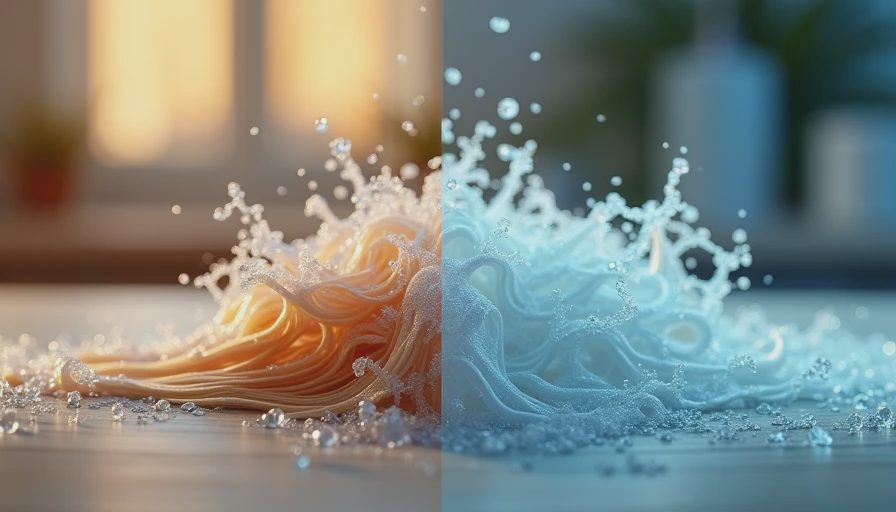
The ingredient list simply says "Dimethicone" – but in the lab, we work with dozens of different grades. They vary by:
Molecular weight (how big the molecules are)
Viscosity (how thick or runny it is)
Volatility (whether it evaporates after application)
Modification (whether it's chemically altered to become water‑soluble)
Type | What It Does | Rinses Off? |
|---|---|---|
High‑molecular‑weight Dimethicone | Forms a durable, heavy film. Great for serums and heat protectants. | Requires strong surfactants (sulfates) to remove. |
Low‑molecular‑weight Dimethicone | Thinner, lighter feel. Adds shine without weight. | Easier to remove, but can penetrate the cuticle slightly. |
Dimethicone Copolyol (water‑soluble silicone) | Provides slip and light conditioning, but washes off with water alone. | Yes – no sulfate needed. |
So when you see "Dimethicone" on a bottle, you don't know which version it is. But as a formulator, I can tell you this: if it's low on the list (after the preservatives), it's almost certainly a lightweight grade added for slip, not for heavy coating.
Who Should Use Dimethicone – and Who Shouldn't?
This is the part where I stop being neutral and give you practical, hair‑type‑specific advice.
Your Hair Situation | My Recommendation on Dimethicone |
|---|---|
Fine, straight, low‑porosity hair | Use sparingly. A little goes a long way. Too much will weigh you down. Stick to lightweight serums, not heavy conditioners. |
Thick, coarse, or high‑porosity hair | Yes, please use it. You need the cuticle smoothing and frizz control. Dimethicone is your shortcut to manageable hair. |
Naturally curly / coily (types 3–4) | Use strategically. Heavy dimethicone can build up and dull curl definition. Try water‑soluble dimethicone (look for PEG‑dimethicone or dimethicone copolyol). |
Chemically damaged / bleached hair | Absolutely use it. Your cuticle is shattered. Dimethicone acts as a temporary "bandage" that reduces further mechanical damage from brushing and styling. |
You use a sulfate‑free shampoo exclusively | Proceed with caution – and clarify once a month. If your shampoo can't remove it, you'll get buildup. |
You use a sulfate shampoo regularly | Use freely. The sulfate will reset the slate with each wash. |
What a Formulator Actually Does With Dimethicone
In my lab years, dimethicone was one of my favourite ingredients – not because it's cheap (good grades are moderately expensive), but because it's predictable.
It doesn't degrade in sunlight.
It doesn't go rancid (unlike natural oils).
It doesn't irritate skin or scalp (it's actually used in baby nappy creams and burn ointments).
If I was making a leave‑in serum for damaged hair, I'd reach for high‑molecular‑weight dimethicone first, because it forms a durable shield that lasts all day.
If I was making a daily lightweight conditioner for fine hair, I'd use a PEG‑modified dimethicone (water‑soluble), because it gives instant slip without any risk of accumulation.
The "silicone‑free" movement made my job harder – not because I'm pro‑chemicals, but because it forced formulators to replace silicones with heavier natural oils (like coconut or castor oil), which actually build up faster, oxidise, and can cause scalp irritation in sensitive people.
My Final Take: Stop Playing Ingredient Police
I don't believe in "good" or "bad" ingredients. I believe in appropriate and inappropriate – for your specific hair, at this specific moment.
If dimethicone gives you shiny, tangle‑free hair with minimal effort, why would you throw that away just to follow an Instagram trend?
If you feel like dimethicone is making your hair limp and lifeless, that's not the molecule's fault – that's frequency and cleansing method issues. Reduce how often you use it, or switch to a water‑soluble version, or add a clarifying shampoo to your rotation.
The label doesn't lie. But it also doesn't judge. Only you can do that.
Read the label before you buy the bottle.





No notes yet — write the first one.