In my last article, I gave you the single most important rule for reading any shampoo label: ingredients are listed in descending order of concentration.
Today, I'm going to tell you why that rule matters more than anything else on the bottle – and why the first five ingredients are the only ones that truly define what a product actually is.
Here's the uncomfortable truth that most brands don't want you to know:
80–90% of what's in that bottle is made up of the first five ingredients. Everything else? It's mostly window dressing.
That fancy botanical extract they're advertising on the front? It's probably at the very bottom of the list – present in such tiny amounts that it's doing almost nothing for your hair.
Let me walk you through what those first five ingredients actually tell you – and how to read them like a formulator.
Why the First Five?
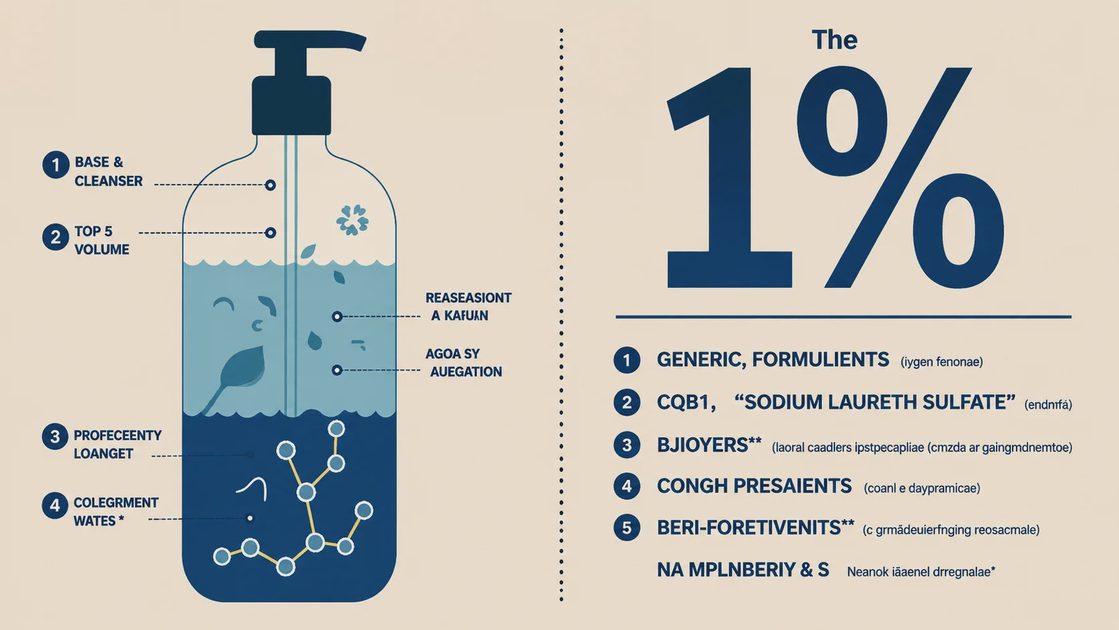
The FDA's ingredient order rule means that the first ingredient on the list is what there's most of. The second is the next most, and so on.
By the time you reach the fifth or sixth ingredient, the concentration has dropped significantly. And once you pass that point, you're often looking at ingredients present at 1% or less.
In China, the threshold is even tighter – ingredients at 0.1% or less must be grouped separately under "Other Trace Ingredients" on the label.
So when a brand claims their shampoo is "infused with Keratin" or "packed with Argan Oil," look at where those ingredients appear on the list. If they're past the fifth spot, they're not doing the heavy lifting. They're marketing theatre – nice to have, but not the star of the show.
What the First Five Ingredients Tell You
Let's break down what you're actually looking for in those first five positions.
Position 1: The Base
Almost always Water (Aqua).
This is normal. This is expected. Shampoos are water-based formulas – typically 70–80% water. If water isn't first, that's unusual and worth noting. (For example, some concentrated cleansers or oil-based pre-shampoo treatments might list a surfactant or oil first.)
What to ask: Is water first? Yes? Good. Move on.
Position 2–3: The Cleansers (Surfactants)
These are the workhorses of your shampoo. They're what actually remove oil, dirt, and product buildup from your hair and scalp.
Strong cleansers (high lather, deep clean):
Sodium Laureth Sulfate (SLES)
Sodium Lauryl Sulfate (SLS)
Ammonium Lauryl Sulfate (ALS)
Milder cleansers (gentler on scalp and hair):
Cocamidopropyl Betaine
Sodium Coco-Sulfate
Disodium Laureth Sulfosuccinate
Sodium Lauroyl Methyl Isethionate
Decyl Glucoside
Position 4–5: The "Balance" Ingredients
Here's where formulators add ingredients that offset the cleansing power – because no one wants hair that squeaks like a dry sponge.
Conditioning agents (add slip and softness):
Fatty alcohols: Cetyl Alcohol, Cetearyl Alcohol, Stearyl Alcohol (important: these are not drying alcohols – they're thickeners and conditioners)
Silicones: Dimethicone, Amodimethicone, Cyclopentasiloxane
Oils and butters: Argan Oil, Shea Butter, Coconut Oil, Jojoba Oil
Humectants (attract and hold water):
Glycerin
Panthenol (Pro-Vitamin B5)
Aloe Barbadensis Leaf Juice
Sodium Hyaluronate
The 1% Rule: Why Everything After the First Five Is Different
Here's something most people don't know: ingredients present at 1% or less can be listed in any order.
That means once you get past the first few ingredients, the order becomes less meaningful. Preservatives, fragrances, colorants, and "hero" ingredients (like keratin, collagen, or botanical extracts) are often added at levels below 1% – and they can be shuffled around on the list without any regulatory consequence.
What does that mean for you?
You cannot judge a product by its "hero" ingredient if it appears near the bottom.
If a product is marketed as a "Keratin Repair Shampoo" but Hydrolyzed Keratin appears after the preservatives – it's a trace addition. It might add some benefit, but it's not what defines the formula.
The real formula is defined by what appears in the first five spots.
A Real-World Example
Let's look at two shampoos side by side.
Shampoo A (marketed as "Gentle & Natural")
Water, Cocamidopropyl Betaine, Sodium Coco-Sulfate, Glycerin, Cetyl Alcohol, Hydrolyzed Quinoa, Aloe Barbadensis Leaf Juice, Citric Acid, Sodium Benzoate, Fragrance
What I see:
Positions 2–3: Mild cleansers (no sulfates).
Positions 4–5: Glycerin (humectant) + Cetyl Alcohol (conditioning fatty alcohol).
Bottom: Quinoa and Aloe are marketing additions – present in tiny amounts.
Verdict: A genuinely gentle shampoo. The mild cleansers and conditioning ingredients are in the right places to do their job. The "natural" ingredients are just extras, but the formula itself is balanced and appropriate for sensitive or dry hair.
Shampoo B (marketed as "Keratin-Infused Strengthening Shampoo")
Water, Sodium Laureth Sulfate, Cocamidopropyl Betaine, Sodium Chloride, Fragrance, Hydrolyzed Keratin, Citric Acid, Sodium Benzoate
What I see:
Positions 2: Sulfate cleanser – strong.
Positions 4–5: Sodium Chloride (salt – used as a thickener, but can be drying) + Fragrance.
Bottom: Keratin – added after fragrance, well below 1%.
Verdict: A strong, lathering shampoo that will clean thoroughly. But the "keratin infusion" is mostly marketing – it's present in such a tiny amount that it's not significantly repairing anything. This shampoo is defined by its cleansers, not its "hero" ingredient.
The One Thing I Want You to Remember
The first five ingredients define the product. Everything else is polish.
If you're looking for a moisturizing shampoo, you need to see moisturizing ingredients (oils, fatty alcohols, humectants) in positions 2–5 – not buried at the bottom.
If you're looking for a gentle shampoo, you need to see mild surfactants in positions 2–3 – not sulfates.
If you're looking for a clarifying shampoo, you want to see strong cleansers and no conditioning ingredients in the top five.
The label is a map. The first five ingredients are the destination. Everything else is just scenery along the way.
Read the label before you buy the bottle.

No notes yet — write the first one.